🏨 Guest Room MEP Preventive Maintenance Guide 🔹 Electrical Systems Inspect light fixtures, switches, and sockets for functionality. Test RCD/MCB breakers for safety. Verify UPS/emergency power supply connections. 🔹 HVAC Systems Check thermostat calibration and cooling/heating performance. Clean air filters and inspect ducts for leaks. Verify fresh air supply and exhaust operation. 🔹 Plumbing Systems Inspect faucets, showers, and WC flush systems for leaks. Test hot/cold water supply and pressure balance. Check drainage flow and trap seals to prevent odors. 🔹 Fire Safety Systems Verify smoke detectors and sprinklers are functional. Inspect fire alarm panel connectivity. Ensure extinguishers are accessible and within expiry. 🔹 Medical Gas Systems (for hospital guest/patient rooms) Inspect oxygen, vacuum, and medical air outlets. Test pressure regulators and alarms. Confirm compliance with NFPA/HTM standards. 📊 Inspection Checklist Format System Task ...
⚙️ Pressure Instrument Selection Guide
🔹 Pressure Gauges
Purpose: Local, visual indication of pressure.
Best For: Routine monitoring, low‑criticality systems.
Notes: Choose Bourdon tube, diaphragm, or digital depending on accuracy needs.
🔹 Pressure Transmitters
Purpose: Convert pressure into electrical signals for remote monitoring/control.
Best For: Integration with SCADA/BMS systems.
Notes: Select based on range, accuracy, and output type (4–20 mA, HART, Modbus).
🔹 Pressure Switches
Purpose: Trigger alarms or control circuits at preset thresholds.
Best For: Safety interlocks, pump/compressor protection.
Notes: Mechanical or electronic; ensure proper setpoint calibration.
🔹 Differential Pressure Instruments
Purpose: Measure pressure difference between two points.
Best For: Filter monitoring, cleanroom airflow, hydronic balancing.
Notes: Select range appropriate to expected ΔP values.
🔹 Pressure Relief Valves
Purpose: Protect equipment from overpressure.
Best For: Boilers, compressors, medical gas systems.
Notes: Must comply with ASME/OSHA codes; size based on maximum allowable working pressure.
📊 Selection Matrix – Quick Comparison
|
|---|
✅ Key Takeaway: Selecting the right instrument depends on accuracy requirements, integration needs, and safety criticality. For example, a hospital medical gas system requires transmitters for monitoring, switches for alarms, and relief valves for safety while a commercial HVAC system may rely primarily on gauges and differential instruments for balancing.
Infographic showing pressure instrument selection guide
1 Design Review
Start Here
Align architectural, structural, and MEP plans before execution.
Review ceiling voids, shafts, and plant rooms
Ensure design intent matches system requirements
Share updated drawings with all stakeholders
2 Clash Detection
Critical
Identify and resolve conflicts between ducts, pipes, and conduits.
Use BIM/Navisworks for 3D clash detection
Highlight overlapping services
Resolve conflicts before site work begins
3 Coordination Meetings
Collaborate across trades to finalize routing and schedules.
Hold weekly service coordination meetings
Update drawings and schedules collaboratively
Document decisions for accountability
4 Installation Sequencing
Define logical order of installation to avoid congestion.
Install large ducts first
Follow with pipes, conduits, and cable trays
Ensure trades work in sequence
5 Compliance Check
Safety
Verify adherence to codes and standards.
Check ASHRAE, NFPA, ISO compliance
Ensure accessibility and safety clearances
Validate fire protection and medical gas layouts
6 Final Inspection
Completion
Confirm system reliability and maintainability.
Conduct on‑site verification
Validate BIM model against installation
Ensure long‑term service accessibility
✅ This workflow infographic emphasizes clarity, safety, and efficiency. It’s ideal for training posters, project presentations, or technician handbooks, ensuring every step from design review to final inspection is followed systematically.
Pressure Instrument Selection Guide infographic, designed for quick technical reference and training use:
⚙️ Pressure Instrument Selection Guide
🔹 Pressure Gauges
Purpose: Local display of system pressure.
Best For: Routine monitoring and low‑criticality systems.
Key Tip: Choose analog or digital based on required precision.
🔹 Pressure Transmitters
Purpose: Convert pressure into electrical signals for remote control.
Best For: Integration with SCADA or BMS systems.
Key Tip: Select output type (4–20 mA, HART, Modbus) per system compatibility.
🔹 Pressure Switches
Purpose: Activate alarms or control circuits at preset thresholds.
Best For: Safety interlocks and pump protection.
Key Tip: Calibrate setpoints carefully for reliable operation.
🔹 Differential Pressure Instruments
Purpose: Measure pressure difference between two points.
Best For: Filter monitoring, cleanroom airflow, hydronic balancing.
Key Tip: Match range to expected ΔP values for accuracy.
🔹 Pressure Relief Valves
Purpose: Protect equipment from overpressure.
Best For: Boilers, compressors, and medical gas systems.
Key Tip: Size according to maximum allowable working pressure and code compliance.
📊 Quick Comparison Table
|
|---|
✅ Key Takeaway: Selecting the right instrument depends on accuracy, integration, and safety criticality. For example, a hospital medical gas system requires transmitters for monitoring, switches for alarms, and relief valves for safety while a commercial HVAC system may rely mainly on gauges and differential instruments for balancing.
Training poster infographic concept for Pressure Instruments, designed for technician education and facility management workshops:
🧭 Pressure Instrument Training Poster
🔹 Pressure Gauges
Purpose: Local pressure indication.
Use: Routine monitoring in HVAC, water, and gas systems.
Tip: Select range 1.5× higher than maximum operating pressure.
🔹 Pressure Transmitters
Purpose: Remote signal conversion for control systems.
Use: SCADA/BMS integration, automated monitoring.
Tip: Choose correct output (4–20 mA, HART, Modbus).
🔹 Pressure Switches
Purpose: Activate alarms or shutdowns at preset limits.
Use: Pump protection, compressor safety.
Tip: Calibrate setpoints and verify hysteresis range.
🔹 Differential Pressure Instruments
Purpose: Measure pressure difference between two points.
Use: Filter monitoring, cleanroom airflow, hydronic balancing.
Tip: Match range to expected ΔP values for accuracy.
🔹 Pressure Relief Valves
Purpose: Prevent overpressure damage.
Use: Boilers, autoclaves, medical gas systems.
Tip: Size per ASME/OSHA code and verify discharge capacity.
📊 Training Comparison Matrix
| ||||||||||||||||||||||||||||||||||
|---|---|---|---|---|---|---|---|---|---|---|---|---|---|---|---|---|---|---|---|---|---|---|---|---|---|---|---|---|---|---|---|---|---|---|
Proper instrument selection ensures measurement accuracy, process reliability, and system safety. For example, in hospital medical gas systems, use transmitters for monitoring, switches for alarms, and relief valves for safety compliance.
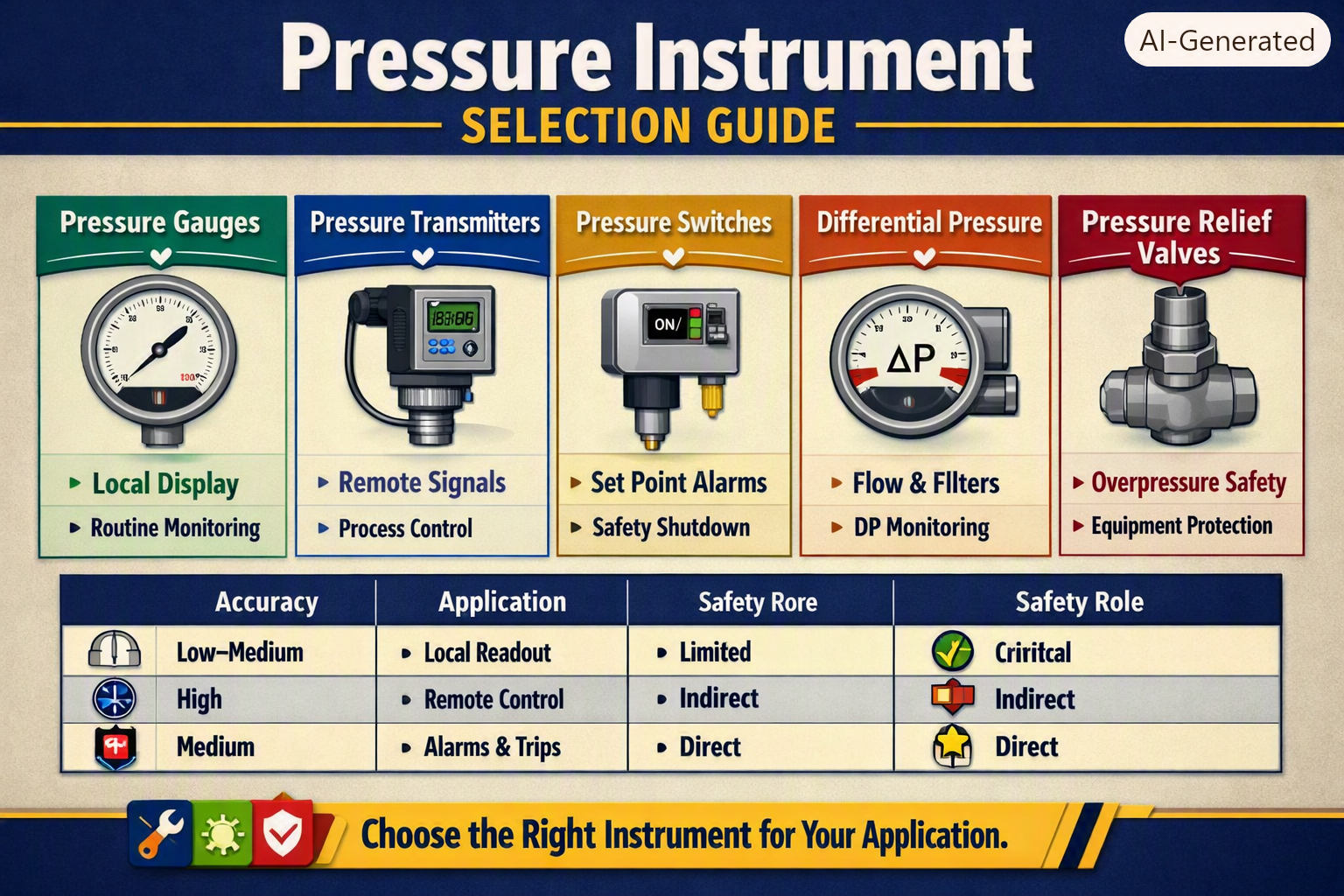
Poster layout design concept for your Pressure Instrument Training infographic, structured to be visually clear and effective for workshops or technician reference:
🧭 Poster Layout – Pressure Instrument Training
🔹 Top Banner
Title: “Pressure Instrument Selection Guide”
Subtitle: “Choose the Right Instrument for Your Application”
Background: Blue gradient with bold white/yellow text.
🔹 Main Body – Five Color‑Coded Panels
Each panel highlights one instrument type with icon, illustration, and key notes:
Pressure Gauges (Green)
Icon: Dial gauge
Text: “Local Display – Routine Monitoring”
Pressure Transmitters (Blue)
Icon: Digital sensor with cable
Text: “Remote Signals – Process Control”
Pressure Switches (Yellow)
Icon: Toggle switch
Text: “Set Point Alarms – Safety Shutdown”
Differential Pressure (Orange)
Icon: ΔP meter
Text: “Flow & Filters – DP Monitoring”
Pressure Relief Valves (Red)
Icon: Relief valve symbol
Text: “Overpressure Safety – Equipment Protection”
🔹 Bottom Section – Comparison Matrix
Table with columns: Accuracy | Application | Safety Role
Rows summarizing each instrument type (Gauge, Transmitter, Switch, Differential, Relief Valve).
Color‑coded cells matching the panels above.
🔹 Footer
Banner: “Accurate Measurement = Reliable Systems = Safe Operations”
Icons: Wrench (maintenance), Gear (process reliability), Shield (safety).
✅ Key Takeaway: This poster layout uses color coding, icons, and concise text to make instrument selection intuitive. It’s ideal for training rooms, workshops, and facility management dashboards.
Comments
Post a Comment